Net Reflector Vspro
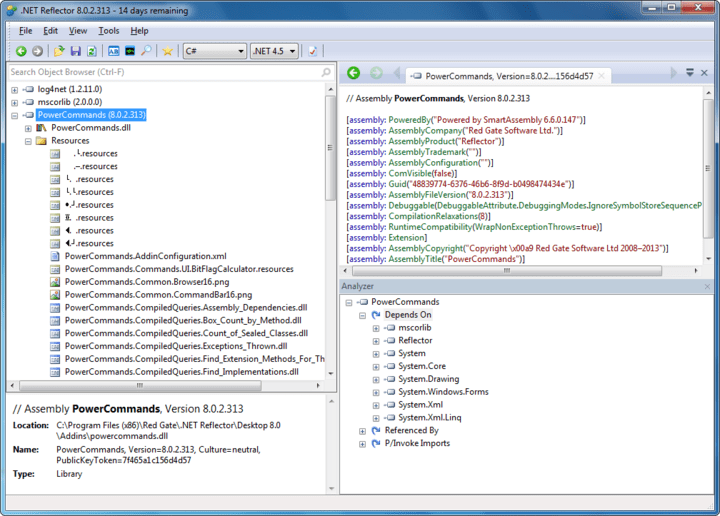
The debugging functionality in.NET Reflector is based in Visual Studio. It lets you use the Visual Studio debugger with decompiled code, so you can step through it, set breakpoints, and so on. However, for debugging scenarios like working with SharePoint, the assemblies are hosted and loaded outside Visual Studio.
Reflector is a class browser. And view the differences between two versions NET Framework.NET Reflector can be used to.NET Reflector 9 VSPro Full. I used to love Reflector back in the day. Kaliro: This is a tool for exploring the content of applications built using the Microsoft.Net framework. Download Red Gate.NET Reflector 8.4.0.35 VSPro Portable or any other file from Applications category. HTTP download also available at fast speeds.
Reflector generates PDB files and allows you to step through the code, but the optimizations made by the CLR mean that you cannot see the values of the local variables. This limits debugging because you cannot watch these values as they change, and properly follow the data flow. In this article, our technical lead Clive discusses a method for enabling locals for debugging sessions attached to the SharePoint w3wpprocesses.
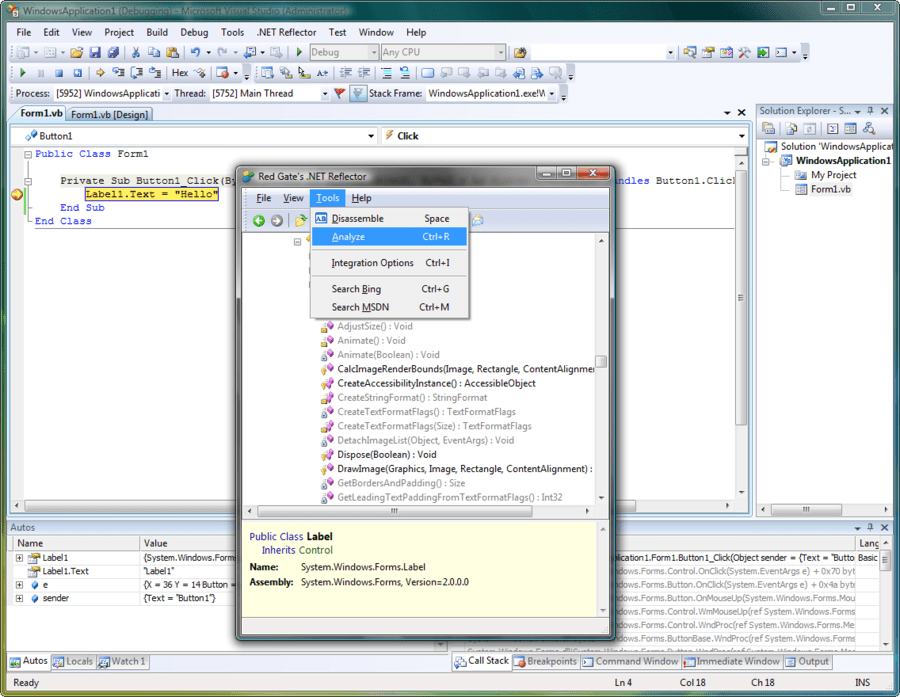
Clive's investigation The CLR is fairly keen on generating efficient code, and so, if you don't have a debugger attached at the time the code is JIT-ed, it's going to do its very best to generate fast (and therefore undebuggable) code. If you later attach a debugger, the CLR as it currently stands generally won't re-JIT methods, so the debugger is not going to give you a very good debugging experience. This became clear recently when I did some experimenting on debugging SharePoint using Reflector VSPro. I'm no expert on SharePoint, and it took quite a while to get a virtual machine together.
Moreover, running SharePoint inside a VM on my work machine brings the machine to a crawl. But we learned a lot from the debugging experience, and I'm going to walk you through it.
Setting up, and having problems Initially, I kicked off a web site and watched the w3wp.exe instances being created using Process Explorer: To enable debugging, I then decompiled the SharePoint assembly using Reflector VSPro: There were a couple of methods that couldn't be decompiled: But it's still possible to attach the debugger to the four worker processes, and start to look at what's going on: In order to start debugging, I needed to locate a source file corresponding to a class that I knew was going to be called. So I navigated into the Reflector cache directory and found the file SPHttpUtility, which I knew would contain the code for the class of the same name. Finding this in Visual Studio, I set a breakpoint on one of its methods: I then used a web browser to get the SharePoint to execute the code. Imagine my dissatisfaction when the debugger couldn't display the local variable values: Without the local values, we can't follow the flow of data through the code, and we can't debug as accurately as we would like.
Enabling debugging for SharePoint locals One problem is that SharePoint is made up of ngen'ed assemblies, and you can't see what's going on in that code. The assemblies are loaded automatically by the CLR, and so prevent us debugging. Disabling optimizations with COMPLUSZAPDISABLE To see the locals, we need to prevent the CLR loading the ngen'd assemblies. Fortunately, this can be done by setting the COMPLUSZAPDISABLE environment variable in the process that loads the CLR itself. This issue is also documented in the MSDN blog post: How to disable optimizations when debugging Reference Source With IIS, I find this easiest to do using the registry entry described in this article on improving the debugging experience. The environment variable prevents the CLR loading the precompiled version of an assembly.
If you set this entry, you'll need to restart the various worker processes, and a useful trick is to use process explorer to check that the environment variable is set in the process, by using the properties tab in the context menu when the process is selected Preventing optimization with.ini files The second problem is that the methods were JIT-ed before the debugger was attached, and hence the code is optimized to some extent. The trick now is to use a.ini file, which the JIT will detect and which can be used to override the optimization level specified in the assembly itself. I went into the GAC, using the Modules window inside Visual Studio to determine where the assembly was actually loaded from. I then made a.ini file, named just as the assembly but with the extension ini instead of dll, and containing the following three lines: In order to try this again, I recycled the w3wp.exe processes in my case by using Process Explorer to kill them, although recycling IIS might have been a slightly tidier way to do it. I then hit the web page, let them start up and attached again. This time, at the same breakpoint, we can see all of the variable values because the code is now unoptimised: Conclusions There are two things to take away, if you want to debug into the SharePoint assemblies, with all the locals visible:.
Prevent the loading of precompiled assemblies Set the COMPLUSZAPDISABLE environment variable in the registry. National nutrition survey philippines. Prevent the optimization of loaded assemblies using the JIT Create.ini files in the same locations as the.dll files you're looking. This will give you a much better debugging experience, even if you attach the debugger to the process after it has started. In my tests there was no impact on system stability, and it's easy to remove the files and re-set the variables when you're done.
Introduction to.NET Reflector Look inside any.NET code. Debug your application Follow bugs through your application to see where the problem is – your own code, third-party libraries, or components used by your application. Understand how applications work Inherited an application with no documentation and no comments? Use.NET Reflector to understand how the code runs and avoid bugs. Look inside APIs, SharePoint, and other third-party platforms Third-party platforms aren't always well-documented.
Use.NET Reflector to look inside their assemblies, and see how they work and which APIs you can call. Try it now, choose your version later. Get insight Find dependencies, diff assemblies, and understand how code works. Debug third-party code fast Using third-party technologies is a great way to get stuff done fast without re-inventing the wheel.
But it's hard to debug libraries, components, and frameworks you didn't write.NET Reflector saves time and simplifies development by letting you see and debug into the source of all the.NET code you work with. Follow bugs through your own code, third-party components, and any compiled.NET code you work with. You can see third-party code in Visual Studio, and debug into it just like your own. See how people are using.NET Reflector to debug third-party code. Learn tech Drill into how.NET languages and frameworks are implemented, and learn how to use them.
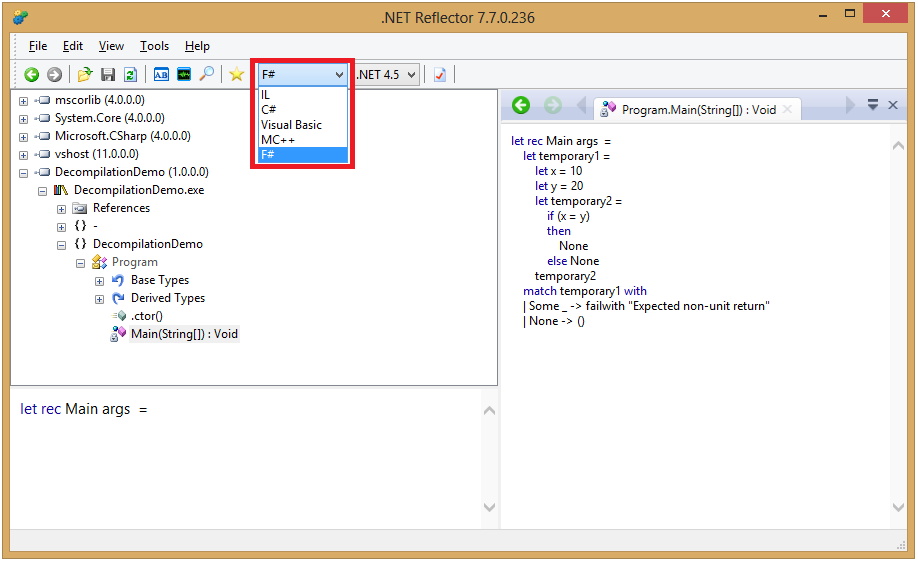
Work easily with any code Languages and libraries aren't always well-documented. Legacy code isn't always well-commented.
Understand how APIs, components, frameworks, and all the critical code you use really works by decompiling and seeing inside. Having the source code available means you're no longer blocked by poor or missing documentation. You can see how code runs, avoid bugs, and develop easily with third-party technologies. See how developers are solving their problems with.NET Reflector.NET Reflector add-ins NET Reflector has a comprehensive add-in model, with an API that lets you extend the tool to suit your exact needs. The API also lets other tools take advantage of.NET Reflector's unparalleled decompilation and disassembly abilities to complement their own functionality. The best thing is, building your own add-in is painless. Below are some great add-ins and tools which we recommend you try out, and there are more you can download.
We've done our best to find some of the best add-ins around, but you can still. Or better still, why not write your own? We have links to some great tutorials to get you started.NET Obfuscation Checker In addition to the add-ins below, Redgate has come up with the.NET Obfuscation Checker, a tool designed to work with.NET Reflector. Obfuscation Checker scans a directory and inspects the assemblies and.exe files inside. It shows you which DLLs and executables are there, the references for each, and information about their obfuscation state and security level.
Net Reflector 8.2.0.42 Vspro
Obfuscation Checker uses.NET Reflector to decompile the assemblies, so you can quickly see the code in a.dll or.exe file. This lets you see what's obfuscated, and what isn't. For example, you can see how readable type names are and how easy it is to understand control flow.