What Do The Cards Mean In The Game Uno
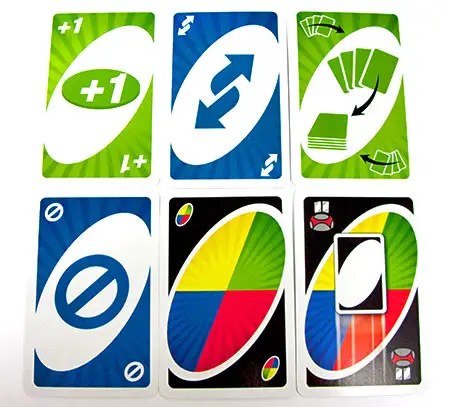
Uno is just a commercial version of the traditional game 'Crazy Eights'. The numbers 0 to 9 mean just what they say. The Reverse means the game play is Reversed. That is if the game play is clockwise, playing a Reverse makes it counterclockwise and vice-versa. The Skip means that the next player is skipped, that is he loses his turn. The Draw Two means the next player must draw two cards and loses his turn. The (regular) Wild can be played at any time.
The Wild Draw Four can only be played if the player is out of the current color. The next player must then draw four cards. When a player plays a (regular) Wild or Wild Draw Four, he must announce the new color. I hope this is clear. Uno is just a commercial version of the traditional game 'Crazy Eights'. The numbers 0 to 9 mean just what they say.
Uno (/ˈuːnoʊ/; from Italian and Spanish for 'one') (stylized as UNO) is an American card game that is played with a specially printed deck (see Mau Mau for an almost identical game played with normal playing cards). The game was originally developed in 1971 by Merle Robbins in Reading, Ohio, a suburb of Cincinnati. A: Each card type in Uno Attack grants a special ability to the player who uses it. The game has seven unique card types: Discard All, Hit 2, Skip, Reverse, Trade Hands, Wild All Hit and Wild Hit Fire.
The Reverse means the game play is Reversed. That is if the game play is clockwise, playing a Reverse makes it counterclockwise and vice-versa. The Skip means that the next player is skipped, that is he loses his turn. The Draw Two means the next player must draw two cards and loses his turn. The (regular) Wild can be played at any time.
The Wild Draw Four can only be played if the player is out of the current color. The next player must then draw four cards. When a player plays a (regular) Wild or Wild Draw Four, he must announce the new color. I hope this is clear.
'When you play this card you gain the ability to make major moves and acquire a card that can improve your hand and get you closer to winning the game. Play the card and your can trade in one card from your hand for a card from any opponent by calling out loud the card you wish to acquire. If an opponent have that card they must acknowledge it and accept whatever card you offer in trade. In the event that there is more than one opponent holding the sought after card, you have the option to trade with both or only one. If no opponent have the sought after card, then you call off the color to follow and play resumes in the direction it was proceeding.' - from the rules of our Bears deck, assume it is the same. Number cards: No special rules.
Worth the same number of points as the number on the card, e.g. A '6' card is worth 6 points. Reverse: Reverses the direction of play, so if t he turn passes to the left it changes to the right. If there are only 2 people playing the opponent misses their next turn as if it was a Skip card. If this comes up as the initial up-card, the dealer goes first and play continues to the right instead of to the left. Worth 20 points.
Skip: The next player misses their next turn. A player who loses their turn in this way is said to have been 'skipped'. If this comes up as the initial up-card, the first player is 'skipped'. Worth 20 points. Draw Two: The next player loses their turn and has to draw 2 cards from the deck. Some 'house' rules state that if this player also has a Draw Two card they can play it on top of yours and the next player must draw 4 cards, etc.If this comes up as the initial up-card, the first player has to draw 2 cards and the next player goes first instead. Worth 20 points.
Wild: This can be played regardless of what the up-card is. If you play this card you must pick a colour for it, then the next player must play either the colour you picked or a wild card.If this comes up as the initial up-card, the first player may play any card. Worth 50 points. Wild Draw Four: Both a wild card and a Draw Two, except the next player obviously has to draw four cards, not two. You can't play this if you have a card of the same colour as the up-card. If this comes up as the initial up-card, put it back in the deck and draw a new initial up-card.
Worth 50 points. Let's say that in clockwise order around the table you have Players A, B, C and D, and the play direction is clockwise at the moment.
Sep 11, 2008 A new beta patch is on its way, as usual stay tuned for all the changes. Beta Realm Maintenance and Patch - 9/10/08 We. Re: importing background image in ProAnimator 3.0.2/running out of memory - Zaxwerks forum for discussion of the Zaxwerks Invigorator and other products - Zaxwerks Forum. [3.0.2, Ubuntu 16.04, g++ 5.4] Can't set background color on Choice controls Showing 1-8 of 8 messages. Jun 17, 2005 importing background image in ProAnimator 3.0.2 - Zaxwerks forum for discussion of the Zaxwerks Invigorator and other products - Zaxwerks Forum. Twrp 3.0.2. Sep 21, 2010 Just installed the update and now the layout which included a background image, the applications folder, and the program icon placeholder results in.
Player A plays a Skip card. Player B's tu rn is skipped; he does absolutely nothing (except catch Player A for not saying 'Uno' if applicable).
Player C can play either a Skip of any color, any card of the color of Player A's Skip card, a Wild card, or, if he doesn't have a card of the current color, a Wild Draw 4. If he plays a Wild or a Wild Draw 4, he calls the color. If it's his second-to-last card, he says 'Uno' before laying down the card. If he has no playable cards or chooses not to play any of the cards he has, he draws one card from the draw pile. If that card is playable, he may play it immediately (after calling 'Uno' again if applicable); if it's not playable he puts it in his hand, and it's Player D's turn. When playing the two-player version, whenever someone plays a Skip (or a Reverse, which acts as a Skip in the two-player version), it's immediately that same player's turn again.
Number cards: No special rules. Worth the same number of points as the number on the card, e.g. A '6' card is worth 6 points.
Uno Card Game Unblocked
Reverse: Reverses the direction of play, so if the turn passes to the left it changes to the right. If there are only 2 people playing the opponent misses their next turn as if it was a Skip card. If this comes up as the initial up-card, the dealer goes first and play continues to the right instead of to the left. Worth 20 points. Skip: The next player misses their next turn. A player who loses their turn in this way is said to have been 'skipped'.
If this comes up as the initial up-card, the first player is 'skipped'. Worth 20 points. Draw Two: The next player loses their turn and has to draw 2 cards from the deck. Some 'house' rules state that if this player also has a Draw Two card they can play it on top of yours and the next player must draw 4 cards, etc.If this comes up as the initial up-card, the first player has to draw 2 cards and the next player goes first instead.
Worth 20 points. Wild: This can be played regardless of what the up-card is.
If you play this card you must pick a colour for it, then the next player must play either the colour you picked or a wild card.If this comes up as the initial up-card, the first player may play any card. Worth 50 points. Wild Draw Four: Both a wild card and a Draw Two, except the next player obviously has to draw four cards, not two. You can't play this if you have a card of the same colour as the up-card.
If this comes up as the initial up-card, put it back in the deck and draw a new initial up-card. Worth 50 points. Number cards: No special rules. Worth the same number of points as the number on the card, e.g. A '6' card is worth 6 points. Reverse: Reverses the direction of play, so if the turn passes to the left it changes to the right.
If there are only 2 people playing the opponent misses their next turn as if it was a Skip card. If this comes up as the initial up-card, the dealer goes first and play continues to the right instead of to the left. Worth 20 points.
Skip: The next player misses their next turn. A player who loses their turn in this way is said to have been 'skipped'. If this comes up as the initial up-card, the first player is 'skipped'. Worth 20 points. Draw Two: The next player loses their turn and has to draw 2 cards from the deck. Some 'house' rules state that if this player also has a Draw Two card they can play it on top of yours and the next player must draw 4 cards, etc.If this comes up as the initial up-card, the first player has to draw 2 cards and the next player goes first instead. Worth 20 points.
Wild: This can be played regardless of what the up-card is. If you play this card you must pick a colour for it, then the next player must play either the colour you picked or a wild card.If this comes up as the initial up-card, the first player may play any card.
Worth 50 points. Wild Draw Four: Both a wild card and a Draw Two, except the next player obviously has to draw four cards, not two. You can't play this if you have a card of the same colour as the up-card.
If this comes up as the initial up-card, put it back in the deck and draw a new initial up-card. Worth 50 points. When a player plays the last card in his/her hand, he/she gets points for all the cards left in all of his/her opponents' hands, as follows:. Reverse = 20.
Play Classic Uno Online
Wild Draw 4 = 50 If the winner of that round does not yet have 500 points, a new round is started. The first player to reach or pass 500 points wins. If more than one player passes 500 in the same round, the player with the higher/ highest point total wins. Let's say that in clockwise order around the table you have Players A, B, C and D, and the play direction is clockwise at the moment. Player A plays a Skip card. Player B's tu rn is skipped; he does absolutely nothing (except catch Player A for not saying 'Uno' if applicable).
Player C can play either a Skip of any color, any card of the color of Player A's Skip card, a Wild card, or, if he doesn't have a card of the current color, a Wild Draw 4. If he plays a Wild or a Wild Draw 4, he calls the color. If it's his second-to-last card, he says 'Uno' before laying down the card.
If he has no playable cards or chooses not to play any of the cards he has, he draws one card from the draw pile. If that card is playable, he may play it immediately (after calling 'Uno' again if applicable); if it's not playable he puts it in his hand, and it's Player D's turn. When playing the two-player version, whenever someone plays a Skip (or a Reverse, which acts as a Skip in the two-player version), it's immediately that same player's turn again.